


Airbnb Toronto Prices: Average Rates, Fees, and Host Income
Table of contents
- Why Pricing Strategy Matters for Toronto Hosts
- Key Factors That Influence Airbnb Toronto Prices
- Property Types and What They Earn in Toronto
- Property Examples: A Practical Guide to Airbnb Pricing in Toronto
- Average Airbnb Toronto Prices by Neighbourhood
- Airbnb Occupancy Rate in Toronto
- Setting and Managing Cleaning Fees as a Host
- Service Fees and Guest Expectations in Toronto
- Is Airbnb Profitable in Toronto?
- Discounts and Long-Term Booking Strategies
- Smart Pricing Tips for Hosts to Stay Competitive
- Understanding Toronto’s Regulations and Pricing Impact
- Buying a Property for Airbnb in Toronto
- Comparative Analysis: Airbnb vs. Hotels in Toronto
- Future Outlook for Short-Term Rental Prices in Toronto
- Conclusion
Key Takeaways
- Airbtics reported an average nightly rate of CAD $168 for February 2025–January 2026.
- AirDNA reported 72% occupancy for the 12 months ending August 2026, measured against available nights.
- Most hosts using Airbnb’s single-fee structure pay 15.5%, with management charged separately.
- Toronto permits ordinary short-term rentals only in a host’s principal residence. Entire-home rentals are capped at 180 rented nights per calendar year.
- Toronto’s Municipal Accommodation Tax is 6% for stays beginning August 1, 2026.
Introduction to Airbnb Toronto Prices for Hosts
Airbnb Toronto prices averaged CAD $168 per booked night in Airbtics’ February 2025–January 2026 report. Among the five neighbourhoods with published rates, averages ranged from CAD $98 to CAD $205. Location and property type affect the nightly rate. Platform fees, cleaning and property costs determine how much of that revenue a host keeps.
Why Pricing Strategy Matters for Toronto Hosts
A nightly rate has to cover the cost of accepting a booking. Platform fees, cleaning and any management charges reduce revenue before the owner pays property expenses.
Start with those costs, then compare nearby listings. Track what bookings leave after expenses across the nights you can offer. A higher advertised rate is useful only when the resulting bookings improve that figure.

Key Factors That Influence Airbnb Toronto Prices
Location and neighbourhood appeal
Compare homes with similar transit access and distance from the places your guests want to visit. A downtown condo and a suburban house serve different needs, even when they have the same bedroom count.
Our Toronto neighbourhood guide explains the areas in more detail. The neighbourhood rate table below provides a separate price comparison.
Seasonality and event demand
Use the same travel dates when checking competing listings. Compare weekdays and weekends separately, and check nearby events before setting prices for those dates.
Keep event bookings separate when reviewing your annual average. A few high-rate nights should not set the budget for the rest of the calendar.
Area popularity and market trends
Track your own booked nights and achieved nightly rate over time. Compare those results with similar properties in the same area.
This helps distinguish a price increase that improves revenue from one that leaves more dates unfilled. Asking prices alone do not show what competing hosts actually earn.
Amenities, services and infrastructure
Check parking, laundry, kitchen access, air conditioning and workspace when comparing otherwise similar homes. Guests should be able to see exactly which features are included and whether any carry an extra charge.
Use the property’s actual amenities when choosing comparisons. A listing with shared facilities belongs in a different comparison from a self-contained home.
Reviews and host reputation
Airbnb’s search guidance identifies ratings, reviews, photos and guest communication as factors in listing quality. Keep photos and descriptions accurate, and address recurring complaints about cleanliness, access or maintenance.
These are practical ways to improve the offer guests see alongside your price.
Property Types and What They Earn in Toronto
The current examples below show how guest quotes vary with rental type, location and travel dates. Each search covers two nights for one adult. The nightly figures divide the quote before taxes by two; they do not represent host payouts or market averages.
| Property type | Example location | Observed quote per night before taxes | Accommodation offered |
| Private room | Mississauga | CAD 72–75.60 | Queen bed and private attached bathroom |
| One-bedroom condo | Downtown Toronto | CAD 245–533 | Entire unit for up to four guests, balcony, and parking |
| Three-bedroom suite | Richmond Hill | CAD 189–213 | Four beds and one bathroom; capacity for eight guests |
| Six-bedroom historic home | Central Toronto | CAD 1,635.90–2,005.50 | Nine beds and three bathrooms; capacity for 14 guests |
December 2026 dates were used for three properties. The condo comparison includes December 2026 and March 2027. The historic home’s lower quote includes a special offer.
Mississauga and Richmond Hill are separate Greater Toronto Area municipalities. Their quotes are retained as nearby comparisons and are separate from the Toronto neighbourhood averages below.
Property Examples: A Practical Guide to Airbnb Pricing in Toronto
These examples compare the prices guests were shown for specific stays. All quotes use one adult, even where a home accommodates more people. Separate cleaning and platform-fee amounts are not itemised in the supplied breakdowns.
In the tables, an asterisk marks a total calculated from the displayed quote and tax amounts. Other totals appear in checkout screenshots. Listing cards can round prices; the exact checkout amount takes precedence where available.
1. Private Room in Mississauga
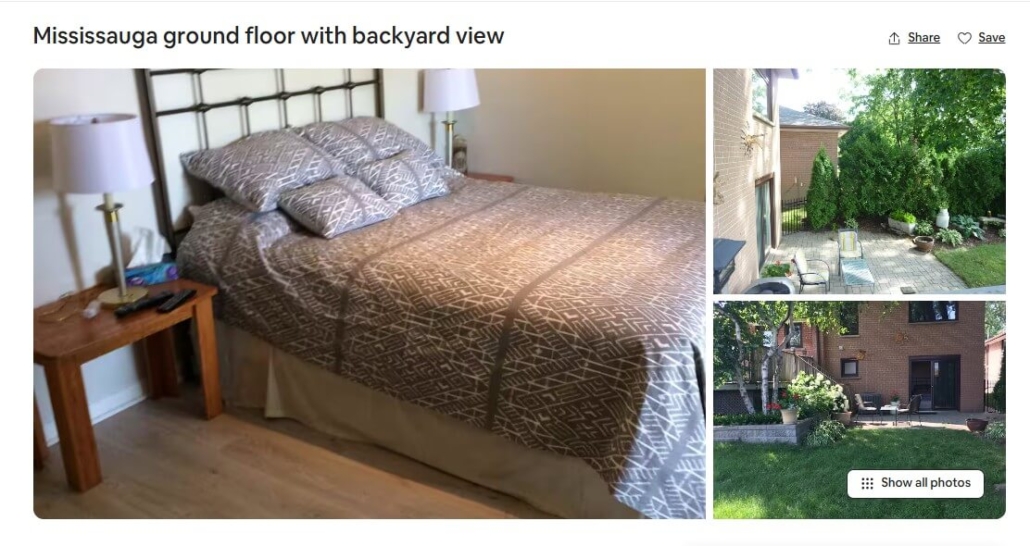
Mississauga ground floor with backyard view offers a queen bed and a private attached bathroom. The supplied listing shows a 4.92 rating from 589 reviews.
| Stay dates | Quote for two nights before taxes | Taxes shown | Total guest cost |
| December 8–10, 2026, Tuesday–Thursday | CAD $144.00 | CAD $27.36 | CAD $171.36 |
| December 4–6, 2026, Friday–Sunday | CAD $151.20 | CAD $28.73 | CAD $179.93 |
Pricing analysis: The weekend quote is 5% higher, moving from CAD $72 to CAD $75.60 per night before taxes. This is the lowest-priced option in the four-property sample. Its offer combines the cost of a private room with an attached bathroom, making privacy a clear feature for a guest comparing room rentals.
The price difference is CAD $7.20 across the stay. For a host, the lesson is to test modest adjustments against similar rooms and review the full guest cost. These two quotes establish the difference for the selected dates; a wider calendar comparison would be needed to identify a recurring weekend rule.
2. One-bedroom condo in Toronto’s Entertainment District

Sunset Views | Entertainment District | Parking is a one-bedroom condo at 30 Nelson Street in downtown Toronto. It accommodates up to four guests with a queen bed and a queen sofa bed. The unit has one bathroom, a private balcony, a fully equipped kitchen, and free parking.
The listing has a 5.0 rating from five reviews. Guests also have access to a gym and sauna. The outdoor hot tub is available in summer.
| Stay dates | Quote for two nights before taxes | Taxes shown | Total guest cost |
| December 8–10, 2026, Tuesday–Thursday | CAD $490.00 | CAD $93.10 | CAD $583.10 |
| March 5–7, 2027, Friday–Sunday | CAD $1,066.00 | CAD $202.54 | CAD $1,268.54* |
Pricing analysis: The quotes equal CAD $245 and CAD $533 per night before taxes. They cover different months, so the difference combines a change in travel dates with a weekday/weekend change. It cannot establish the condo’s weekend premium.
The December quote is higher than the Richmond Hill three-bedroom suite’s CAD $378 for the same dates and one-adult search. That shows why bedroom count alone is an incomplete pricing comparison. This condo’s offer centres on a private downtown stay, parking and nearby attractions. The summer-only hot tub should be left out when assessing the amenities available for these quoted stays.
3. Three-bedroom guest suite in Richmond Hill
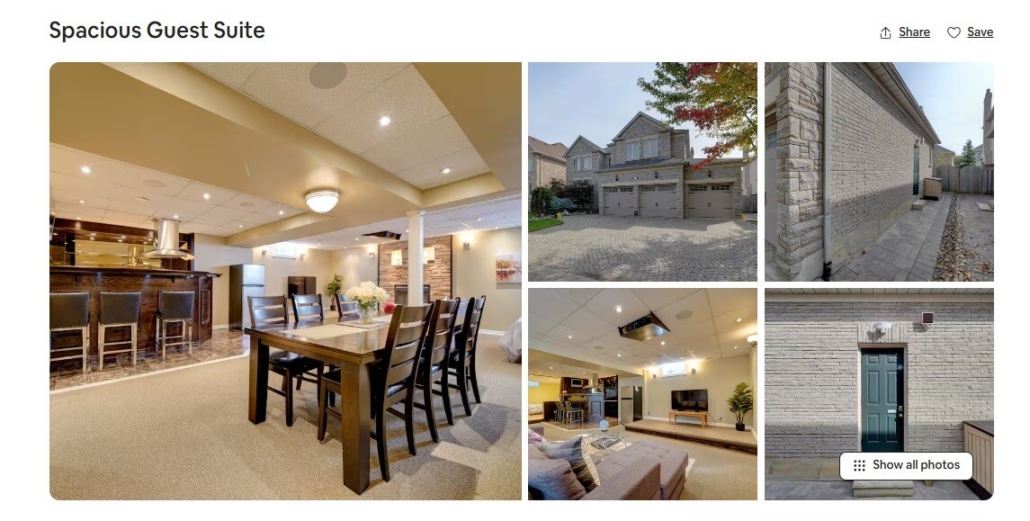
The Spacious Guest Suite has three bedrooms, four beds and one bathroom, with a listed capacity of eight guests. Its Airbnb description includes a kitchen, living area, separate entrance, parking and self-check-in. The supplied screenshot shows a 4.8 rating from 245 reviews.
| Stay dates | Quote for two nights before taxes | Taxes shown | Total guest cost |
| December 8–10, 2026, Tuesday–Thursday | CAD $378.00 | CAD $49.14 | CAD $427.14* |
| December 11–13, 2026, Friday–Sunday | CAD $426.00 | CAD $55.38 | CAD $481.38* |
Pricing analysis: The sampled weekend quote is 12.7% higher, increasing from CAD $189 to CAD $213 per night before taxes. The rise is CAD $48 across the two-night stay, a larger percentage adjustment than the Mississauga room’s 5% change.
The configuration offers several bedrooms and living space, while one bathroom remains an important comparison point for guests considering a group stay. Hosts should compare similar suites on both bedroom and bathroom counts. The quoted search is for one adult; an eight-guest price was not checked, so these figures should not be converted into a claimed cost per person for a full group.
4. Six-bedroom historic home in central Toronto
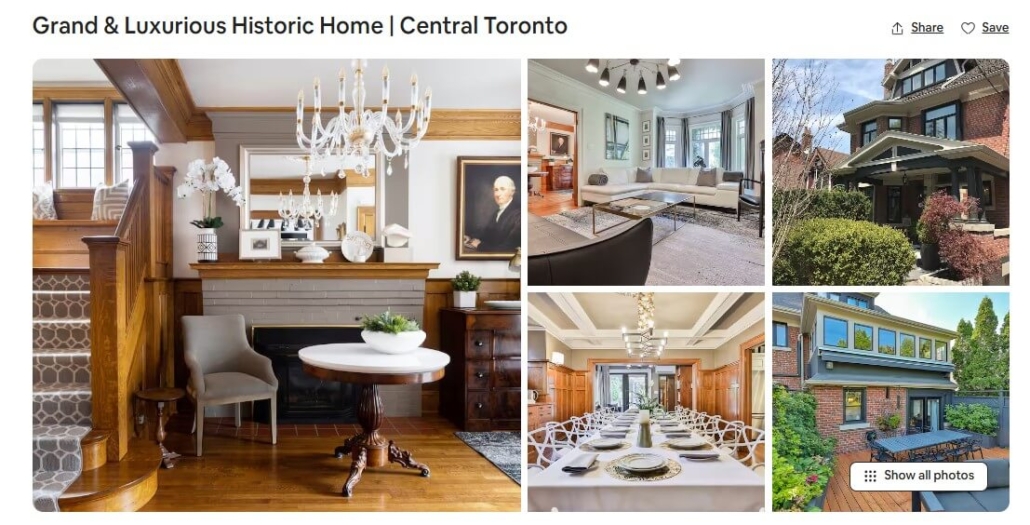
The Grand & Luxurious Historic Home has six bedrooms, nine beds and three bathrooms, with capacity for 14 guests. The supplied screenshot shows a 5.0 rating from 155 reviews and Airbnb’s top 1% label.
| Stay dates | Quote for two nights before taxes | Taxes shown | Total guest cost |
| December 8–10, 2026, Tuesday–Thursday | CAD $4,011.00 | CAD $240.66 | CAD $4,251.66* |
| December 4–6, 2026, Friday–Sunday, after special offer | CAD $3,271.80 | CAD $196.31 | CAD $3,468.11 |
Pricing analysis: The weekend checkout starts at CAD $4,005 and subtracts a CAD $733.20 special offer, a discount of 18.3%. The resulting quote is CAD $3,271.80 before taxes, displayed as CAD $3,272 on the rounded listing card.
Before that offer, the weekend and weekday quotes are almost equal. After the offer, the weekend quote is 18.4% lower than the weekday quote. The visible discount explains this result; the screenshots do not show why it was offered.
For hosts, this example shows the importance of checking promotions alongside calendar rates. Assess a discount against the booking’s return after platform fees, management and property costs. The six-bedroom home also needs comparisons with similarly sized homes; its advertised capacity alone does not establish the price for a 14-guest booking.
Average Airbnb Toronto Prices by Neighbourhood
Airbtics’ Toronto report publishes average nightly rates for these five neighbourhoods:
| Toronto neighbourhood | Average nightly rate | Listings in the sample |
| Yonge-St. Clair | CAD $205 | 12 |
| Danforth East York | CAD $146 | 27 |
| Thistletown-Beaumond Heights | CAD $128 | 14 |
| Yorkdale-Glen Park | CAD $115 | 73 |
| Thorncliffe Park | CAD $98 | 9 |
Source: Airbtics report updated March 12, 2026. Citywide figures cover February 2025–January 2026. Separate reporting periods and property-type filters are not supplied for the neighbourhood figures.
Airbtics’ rate definition includes platform service fees and discounts. It excludes cleaning, extra guest and pet fees, and taxes. The table therefore represents a different amount from the payout a host receives.
For a current comparison, search identical dates and guest numbers, then record the accommodation subtotal, cleaning charge and final guest price.
Airbnb Occupancy Rate in Toronto
AirDNA reported 72% occupancy across its Toronto short-term rental sample for the 12 months ending August 2026. Its data cover listings on Airbnb, Vrbo and Booking.com.
Airbtics’ earlier report recorded a median occupancy rate of 70% for February 2025–January 2026. The two figures come from different datasets and periods.
Occupancy measures booked nights as a share of available nights:
Occupancy = booked nights ÷ available nights × 100
For example, a home offered for 180 nights and booked for 108 has 60% occupancy. That is the booking pattern used in the income example below.
Toronto’s 180-night entire-home limit counts nights actually rented. It is separate from the number of nights a host makes available.
Setting and Managing Cleaning Fees as a Host
Cleaning is a cost per turnover. Shorter stays spread that cost across fewer nights, which affects both the guest’s total price and the host’s margin.
Set the charge using a quote for your home’s size, laundry and turnover requirements. A written Airbnb cleaning checklist helps define the work included.
Review the final guest price for your usual stay lengths. A cleaning charge that works for a week-long visit can make a short booking expensive compared with nearby alternatives.
Service Fees and Guest Expectations in Toronto
Under Airbnb’s single-fee structure, most hosts pay 15.5%, deducted from their payout. The fee applies to accommodation and host-added charges, including cleaning, but excludes taxes. Guests pay no separate Airbnb service fee under this structure.
Bookings made before a host switched retain their original fee structure, according to Airbnb’s transition guidance. Use the fee shown in each reservation breakdown, including any service-fee tax you cannot recover.
MasterHost’s Toronto management packages are Basic 12%, Full 15% and Premium 18% per booking. Management is charged separately from Airbnb’s platform fee. Check the package’s services, commission base and applicable taxes when comparing costs.
Accommodation taxes and GST/HST
Toronto’s Municipal Accommodation Tax is 6% for stays beginning August 1, 2026. The temporary 8.5% rate ended July 31. For ordinary home rentals, Airbnb applies Toronto MAT to the listing price and cleaning fee on stays of 27 nights or fewer.
Hosts must file quarterly MAT reports even when Airbnb collects the tax or the home earns no rental income. Tax collected for remittance stays separate from hosting revenue.
Ontario’s HST rate is 13%. HST-registered operators also charge HST on MAT.
For most businesses, GST/HST registration becomes mandatory when qualifying taxable sales exceed CAD $30,000 in one calendar quarter or over the previous four (or fewer) consecutive calendar quarters. The total includes qualifying worldwide revenue from all your businesses and associates, before expenses such as platform fees. The date you must start charging tax depends on which test you meet.
Under Airbnb’s Canadian tax policy, Airbnb collects accommodation GST/HST on taxable stays when the host has not supplied a registration number. Registered hosts account for their own GST/HST.

Is Airbnb Profitable in Toronto?
Airbnb can generate a profit from an eligible Toronto home. To calculate it, subtract platform fees, management, cleaning and property expenses from accommodation revenue. Mortgage payments then affect the cash left for the owner.
A simple annual income calculation
This illustration uses 108 booked nights at CAD $200 per night and a CAD $10,800 annual expense budget for cleaning, utilities, maintenance, supplies, insurance and hosting’s share of ownership costs.
| Annual item | Calculation | Amount |
| Accommodation revenue | 108 nights × CAD $200 | CAD $21,600 |
| Airbnb platform fee | 15.5% of revenue | −CAD $3,348 |
| Management | Example: 15% of accommodation revenue | −CAD $3,240 |
| Cleaning and property expenses | Example annual budget | −CAD $10,800 |
| Toronto registration renewal | 2026 fee | −CAD $390 |
| Operating profit before financing and income tax | Revenue minus listed costs | CAD $3,822 |
The example has no separate guest cleaning charge. Amounts exclude GST/HST; add any tax you cannot recover to expenses.
The operating margin is 17.7%: CAD $3,822 ÷ CAD $21,600 × 100. Mortgage payments and income tax reduce the amount the owner keeps.
Replace the nightly rate, booked nights and expense budget with your property’s figures. Our Airbnb profit margin guide explains the revenue and cost categories in more detail.
Discounts and Long-Term Booking Strategies
Airbnb supports weekly discounts for stays of seven nights or more and monthly discounts for stays of 28 nights or more.
A longer booking can reduce turnover work, but its discounted revenue still needs to cover fees and property costs. Calculate the amount left after those expenses before choosing a discount.
Monthly bookings also require a review of building, tenancy and tax requirements, covered in the buying section below.
Smart Pricing Tips for Hosts to Stay Competitive
- Compare the same booking. Match travel dates, guest count, rental type and bedroom count before comparing the full guest price.
- Set a cost floor. Include platform fees, management, turnover and property costs when deciding the lowest rate you can accept.
- Review unbooked dates. Check how your price and minimum stay compare with similar homes for those dates.
- Check automatic pricing and discounts together. Airbnb’s Smart Pricing allows minimum and maximum prices and manual overrides. Discounts can bring the guest’s price below the Smart Pricing minimum.
- Measure results after expenses. Track achieved rates, booked nights and the revenue left after costs.
Understanding Toronto’s Regulations and Pricing Impact
Toronto permits ordinary short-term rentals only in a host’s principal residence. The City’s registration rules distinguish two types of hosting:
- Entire-unit rental: The host rents the whole home while away, for up to 180 nights per calendar year.
- Partial-unit rental: The host remains living in the home and rents up to three bedrooms, with no annual night cap. The advertised bedroom count must be at most one fewer than the home contains.
Partial-unit operators cannot rent the entire dwelling under that registration. A separate basement or laneway suite must itself be the host’s principal residence to qualify.
Registration types can change only at renewal. If an entire-unit registration applies during a calendar year, nights rented under either type count toward that year’s 180-night cap.
Registration and renewal each cost CAD $390 in 2026. Include the fee and the permitted hosting nights in your annual budget.
Read Toronto Airbnb License Guide 2026: Yorkville Rules.
Buying a Property for Airbnb in Toronto
A separate investment condo cannot be registered for ordinary stays under 28 consecutive days. A home you buy must become your principal residence to qualify for Toronto short-term rental registration.
Before making an offer, check the condo declaration and rules, lender requirements and hosting insurance. Include the full mortgage, property tax, condo fees, furnishing and maintenance costs in the purchase budget. Our Toronto property buyer guide covers the purchase process in more detail.
Stays of 28 nights or longer fall outside Toronto’s municipal short-term rental definition. Building, tenancy and tax rules still apply. The CRA also denies deductions for non-compliant short-term rentals, using a definition that covers properties rented or offered for less than 90 consecutive days.
Comparative Analysis: Airbnb vs. Hotels in Toronto
Compare the total cost for the same dates, number of guests and required space. A nightly apartment rate and a single hotel-room rate may represent very different accommodation.
| Comparison point | What to check in both options |
| Total stay cost | Accommodation, cleaning, parking, mandatory charges and taxes |
| Space | Bedrooms, bathrooms, sleeping arrangements and privacy |
| Facilities | Kitchen, laundry, workspace and any paid amenities |
| Service and terms | Housekeeping, access arrangements, support and cancellation conditions |
For an entire apartment, compare a hotel option that provides the space your guests need. For a private room, compare the bathroom access and shared facilities as well as the price. This gives a Toronto host a more useful basis for pricing than a citywide hotel average.
Future Outlook for Short-Term Rental Prices in Toronto
For future dates, review the prices guests can book now and your own booking pace. Recheck the comparison as the stay approaches, especially around events and weekends.
Build income forecasts from achieved rates and available nights. Update them when booking results, fees or ownership costs change.
Conclusion: Mastering Airbnb Toronto Prices as a Host
Use neighbourhood data for context, then set rates against comparable homes for the dates you can offer. Calculate revenue after fees, cleaning and property expenses, within Toronto’s registration rules.