

Airbnb Minimum Stay: How to Set It for Profit
Key Takeaways
- Minimum stay is not just a detail. It controls search visibility, guest quality, turnover cost, and profit, so you should set it on purpose, not copy others.
- Longer minimums raise booking value and reduce cleanings; shorter minimums boost occupancy and fill gaps. Pick what protects profit after cleaning.
- Adjust your rules by season, weekday vs weekend, and events. Tighten for peak weekends and holidays, relax for slow periods and single “orphan nights.”
- Set it directly in your Airbnb calendar: choose a global minimum, then apply custom rules for Fridays, holidays, and last-minute gaps to protect revenue.
- Track results. Watch RevPAR after cleaning, average stay length, 5-star reviews, and turned-down inquiries. Test, compare for a few weeks, and update.
Introduction
Setting the right Airbnb minimum stay can make or break your earnings. Because stay length shapes occupancy, it also affects cleaning load, pricing power, and reviews. Therefore, you need a clear method, not guesswork. In this guide, you’ll learn how to choose, test, and refine your Airbnb minimum stay so it fits your market, your calendar, and your goals. For hands-on help with data-driven setup, dynamic pricing, and Airbnb minimum nights rules, partner with MasterHost.
What Is an Airbnb Minimum Stay?
Your Airbnb minimum stay is the shortest reservation you allow. Although it sounds simple, this one rule influences demand, revenue, and operations. For example, a 2-night minimum cuts down one-night requests, which reduces turnover but could leave small gaps on your calendar. Conversely, a 1-night minimum boosts search visibility and fills gaps, yet it increases cleaning frequency. Therefore, you should align this rule with your costs, your cleaning capacity, and your pricing strategy.
Why the Airbnb Minimum Stay Matters for Profit
Your Airbnb minimum stay drives both occupancy and average booking value. Short stays usually lift occupancy, while longer stays typically raise revenue per booking and reduce changeovers. Because cleaning fees and resets eat into margins, longer stays often improve net profit. However, short stays can command a higher nightly rate, especially in high-demand cores. As a result, the best choice depends on your market’s booking behavior and your cost structure.
How Search Visibility Responds to Minimums
Platforms surface listings that match traveler filters. When many guests filter for “1 night,” a rigid Airbnb minimum stay of 3 nights may push you out of results. On the other hand, when visitors search weekend getaways of 2–3 nights, a 1-night minimum may bring low-value bookings that block better ones. Therefore, use flexible windows and trip-length discounts to stay visible without sacrificing yield.

Calculating Your Operational Break-Even
Before you set an Airbnb minimum stay, add up your per-booking costs. Include cleaning, laundry, restocking, your time, and wear and tear. Then spread that total across the number of nights in a typical stay.
Example: if cleaning is 60 and your 1-night rate is 120, cleaning alone eats 50% of the booking value. If you raise the Airbnb minimum stay to 2 nights at 120 per night, the same 60 in cleaning becomes 25% of a 240 booking. Your minimum should never push your margins below your target.
Market Research: Benchmark the Airbnb Minimum Stay
Start with comps. Look at 10–15 similar listings near you. Note their Airbnb minimum stay, base rates, fees, and occupancy patterns. Because seasonality shifts behavior, compare at least two periods, like shoulder vs high season. Then evaluate reviews to see if guests complain about strict minimums. This scan gives you a baseline, which you can tweak with your brand positioning and amenities.
Seasonality: Adjust the Airbnb Minimum Stay by Month
Demand changes by season. Therefore, your Airbnb minimum stay should move with it. In peak periods, longer minimums protect your calendar from low-value gaps and increase average revenue per booking. In slow months, shorter minimums capture spontaneous trips and business travelers. Additionally, midweek stays often behave differently from weekends. As a result, split rules by weekday vs weekend whenever your market supports it.
Events and Holidays: Strategic Airbnb Minimum Stay
Major events compress demand into a short window. Because turnover time is scarce, increase your Airbnb minimum stay for those dates. For example, set 3–4 nights for a festival week to avoid one-night bookings that block your ability to host higher-value guests. Additionally, pair this with dynamic pricing to reflect spike days and shoulder nights. Therefore, you earn more per clean and reduce stress on your team.
Pricing Strategy: Pair Minimum Stay with Smart Rates
Your Airbnb minimum stay works best when pricing supports it. If you push to a 3-night minimum, consider a nightly discount for 4–6 nights and a weekly discount for 7+ nights. Because guests compare totals, length-of-stay discounts encourage longer bookings without lowering your headline rate. Conversely, if you accept 1-night stays, raise the nightly price or add a modest cleaning fee so short bookings remain profitable.
Gap Management: Fill Unbookable Nights
Even with a strong Airbnb minimum stay, gaps happen. Therefore, use rule-sets that relax the minimum for “orphan” nights between two bookings. For example, allow 1-night reservations only when there is a single open night. Additionally, enable last-minute rules that drop minimums 3–5 days before check-in. As a result, you convert stranded inventory without training guests to expect short stays year-round.
Weekday vs Weekend: Split the Airbnb Minimum Stay
Traveler intent changes across the week. Business and solo travelers often book 1–2 nights Monday to Thursday. Leisure groups usually book 2–3 nights from Friday to Sunday. Therefore, split your Airbnb minimum stay by weekday. Set 1–2 nights midweek to capture business demand, and set 2–3 nights on weekends to protect turnover time and attract higher-value leisure bookings.
Cleaning Capacity and Team Constraints
Your team’s bandwidth should shape your Airbnb minimum stay. When cleaners are stretched, frequent turnovers create stress and errors. Consequently, longer minimums smooth schedules and improve quality. Additionally, longer stays reduce checklists, linen cycles, and consumables. Because guest experience drives reviews, protecting your team often pays for itself through higher ratings and fewer issues.

Legal Rules That Affect the Minimum
Some cities regulate short stays or require a minimum length for certain zones or license types. Therefore, confirm what your area allows before you set an Airbnb minimum stay. Additionally, building bylaws and HOA rules may restrict weekend-only or one-night bookings. As a result, align your listing rules with local compliance to avoid penalties and sudden disruptions.
How to Set the Airbnb Minimum Nights in Your Listing
Your Airbnb minimum nights setting lives in the calendar. You control it per listing, and you can also apply custom rules to certain dates.
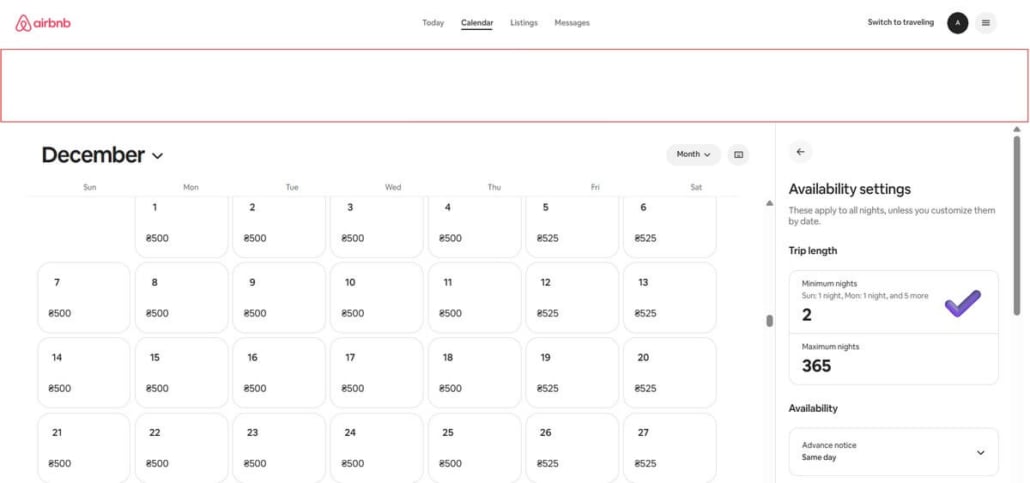
On desktop:
- Go to Calendar for the listing you want to edit.
- In the right-hand panel, click Availability.
- Find Trip length.
- Under Minimum nights, enter the fewest nights you want to allow.
- Click Save.
This updates the global minimum stay for that listing going forward.
To set different minimums for certain days or weekends:
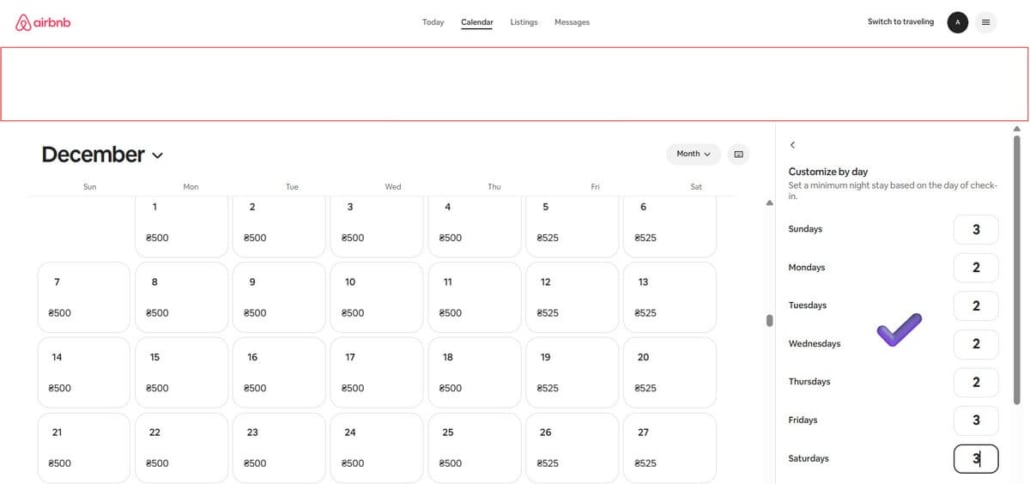
- In the same Trip length area, select Customize by check-in day (wording may appear as “Custom trip length” or “Minimum nights by check-in day”).
- Set rules like “2-night minimum if check-in is Friday” and “1-night minimum for other days.”
- Save.
This is useful if, for example, you only want full weekend bookings instead of single-night party risk
To set a special minimum for specific dates (events, holidays, peak weeks):
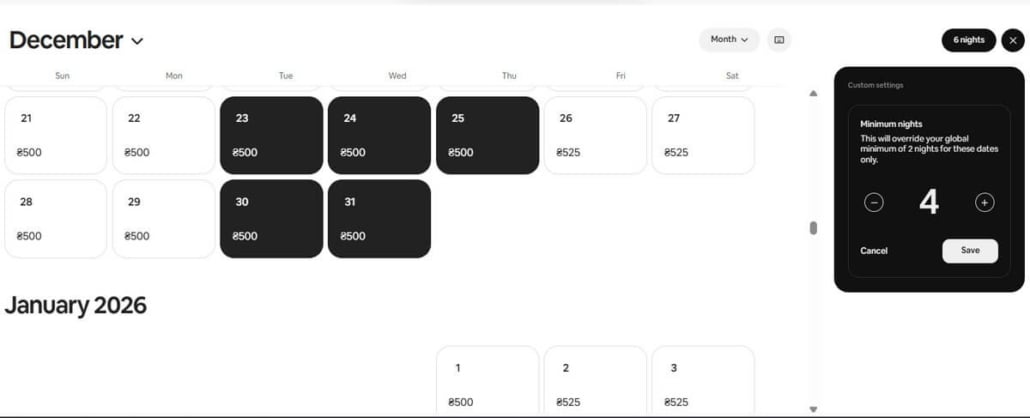
- In your Calendar, drag to highlight the exact date range (for example, Dec 23-25).
- A side drawer or pop-up will open for those dates.
- Edit Minimum nights for that range.
- Save.
That creates a custom rule only for those dates and overrides your normal minimum.
Data You Must Track to Improve
To refine your Airbnb minimum stay, track key metrics monthly. Monitor average length of stay, occupancy, revenue per available night (RevPAR), cleaning hours per booking, and 5-star review percentage. Additionally, log inquiry patterns you turn away due to minimums. Because data reveals trade-offs, you will see whether a 2-night rule increases RevPAR after cleaning and whether reviews improve when turnover drops.
Airbnb Minimum Stay: Testing & Optimization
Run 4–6 week tests per setting. For example, test 1-night vs 2-night minimums in shoulder season. Keep pricing and photos constant so you isolate the effect of the Airbnb minimum stay. Then compare occupancy, RevPAR, and reviews. If 1-night boosts occupancy but slashes profit, shift to 2 nights and add a “gap night” override. Because markets evolve, repeat tests each season.
Messaging: Explain the Value to Guests
Clear copy reduces friction. In your description and house rules, explain why your Airbnb minimum stay helps maintain quality and fair pricing. For example, note that longer stays allow deeper cleaning and better rates. Additionally, invite guests with special requests to reach out about filling gap nights. Because honest messaging builds trust, you will convert more inquiries and avoid complaints.

Listing Tactics That Support Your Minimum
You can reinforce your Airbnb minimum stay with smart listing choices. Add weekly and monthly discounts to nudge longer trips. Offer early check-in or late check-out for 3+ nights. Provide a mid-stay refresh for 5+ nights. Additionally, highlight amenities that reward lingering, like chef’s kitchens, desks, blackout curtains, and washers. As a result, your stay length will rise naturally.
Neighborhood and Product Fit
Match your Airbnb minimum stay to product-market fit. Downtown studios near transit often thrive with short business stays. Family houses near parks usually perform better with 3–5 night leisure trips. Ski homes and beach villas typically benefit from week-long bookings. Therefore, shape your minimum to the guest you serve best, not an average of everyone.
Multi-Unit Hosts: Stagger Your Rules
If you manage several units, vary the Airbnb minimum stay by unit type. Keep at least one listing open to short stays to catch late demand. Set others at 2–3 nights for stable turnover. Additionally, hold a larger unit for week-long trips. Because mix matters, this spread lets you accept profitable bookings while keeping calendars balanced.
Handling Cancellations and Re-Selling Nights
Cancellations can create awkward gaps. Therefore, pair a flexible or moderate policy with targeted last-minute drops in the Airbnb minimum stay to resell canceled nights. Additionally, enable instant book for verified travelers during these windows. As a result, you will recover revenue without permanently loosening your standards.

Communication Templates That Defend Your Minimum
Guests may ask for exceptions. Use a friendly template that references your Airbnb minimum stay, explains cleaning logistics, and offers alternatives. For example: “Thanks for your interest. Our Airbnb minimum stay is 2 nights to keep rates fair and quality high. However, we can host 1 night if it fills the single gap on [date]. Let me know if that works.” Because this tone is helpful, guests accept your rules more readily.
Using Discounts Without Undermining Value
Discounts can complement your Airbnb minimum stay when used with care. Offer a modest percent off for 4–6 nights and a deeper weekly discount. Additionally, add a monthly discount that targets slow seasons. Because the base rate stays firm, your positioning remains premium while your totals encourage longer commitments.
Airbnb Minimum Stay: Tech Tools and Automation
Rule-sets, dynamic pricing tools, and channel managers help you operationalize your Airbnb minimum stay. Set weekday vs weekend rules, event windows, orphan-gap exceptions, and last-minute drops. Additionally, sync calendars across platforms to prevent double bookings and preserve your rules. As a result, you maintain control while saving time.
Photography and Amenities That Stretch Stays
Photos should sell comfort over multiple nights. Emphasize real cooking setups, comfortable seating, and functional work areas. Because visuals shape expectations, guests will self-select into longer trips that fit your Airbnb minimum stay. Additionally, add small touches like extra hangers, luggage racks, and board games. These cues signal a home base, not a pit stop.
Reviews and Social Proof
Longer stays often produce richer experiences and better reviews. Therefore, remind guests of mid-stay support, such as fresh towels or local tips for day three. Because service depth improves satisfaction, your ratings will reflect it. Over time, high ratings raise visibility, which multiplies the impact of your Airbnb minimum stay choices.
Airbnb Minimum Stay Common Mistakes to Avoid
First, don’t copy a competitor’s Airbnb minimum stay without testing. Markets differ block by block. Second, don’t set long minimums during slow months, because you will choke demand. Third, don’t allow 1-night bookings during peak weekends if cleaning capacity is tight. Finally, don’t forget to revisit rules as your costs and guests evolve. Because change is constant, your settings should be too.
Airbnb Minimum Stay Step-by-Step Setup Checklist
- Audit costs. Calculate cleaning and turnover time per booking.
- Research comps. Benchmark Airbnb minimum stay by season and unit type.
- Define goals. Choose occupancy vs margin priorities per month.
- Set rules. Split weekday vs weekend. Add event windows.
- Protect gaps. Use orphan-night overrides and last-minute drops.
- Align pricing. Add length-of-stay discounts that reward longer trips.
- Automate. Use tools to enforce your Airbnb minimum stay consistently.
- Test. Run 4–6 week experiments and compare RevPAR after cleaning.
- Message. Explain your policy and invite gap-night inquiries.
- Review. Iterate monthly based on data and guest feedback.
Final Thoughts: Make Your Airbnb Minimum Stay Work Harder
Your Airbnb minimum stay is not a set-and-forget switch. Because it touches profit, workload, and guest experience, you should keep refining it with real numbers and clear rules. If you pair smart pricing with flexible gap management, your Airbnb minimum stay will protect margins while keeping calendars healthy. As a result, you will host happier guests and grow sustainable revenue month after month.