


What Is an Airbnb Cap Rate and Why Should Hosts Care?
Table of contents:
Key Takeaways
- The cap rate turns your property’s annual net earnings into a clear percentage so you can measure real performance at a glance.
- Short-term rental hosts typically look for cap rates between 5% and 10%, though your local market, property style, and seasonal patterns will shape that target.
- Accurate cap rate depends on honest expense tracking, because every hidden cost chips away at the return you think you are earning.
- Expensive housing markets tend to compress cap rates since high purchase prices offset otherwise healthy booking revenue.
- Checking your cap rate on a quarterly basis helps you catch shifts in occupancy or spending before they become bigger problems.
It’s interesting to know The Best Markets for Airbnb in the World.
Introduction
Most Airbnb hosts can tell you their average nightly rate. Fewer can tell you whether their property is actually making money once every bill is paid. That gap between perceived income and true profitability is exactly what the Airbnb cap rate is designed to close.
Cap rate, or capitalization rate, boils your rental’s financial performance down to a percentage. It answers a straightforward question: for every dollar this property is worth, how many cents does it actually earn in a year? If you are running an Airbnb or thinking about buying one, this number deserves your attention. Here is everything you need to know about it.
Why Airbnb Hosts Need a Profitability Yardstick
Booking revenue alone can be misleading. A listing that collects $3,500 per month sounds great until you subtract cleaning fees, platform commissions, property taxes, insurance, and the occasional broken dishwasher. What remains is what truly matters.
Cap rate gives you that “what remains” figure as a percentage of your property’s market value. It removes emotions and assumptions from the equation and replaces them with a concrete number you can track, compare, and act on.
This is especially relevant for short-term rentals. Unlike a traditional lease where income and costs stay relatively flat month to month, Airbnb hosting involves fluctuating nightly rates, variable guest turnover expenses, seasonal booking swings, and platform fee adjustments. Cap rate absorbs all of that noise and distills it into one metric.
Explore Airbnb Tips & Tricks for Hosts: Maximize Revenue, Occupancy & Efficiency.
The Airbnb Cap Rate Formula Explained
Here is the calculation:
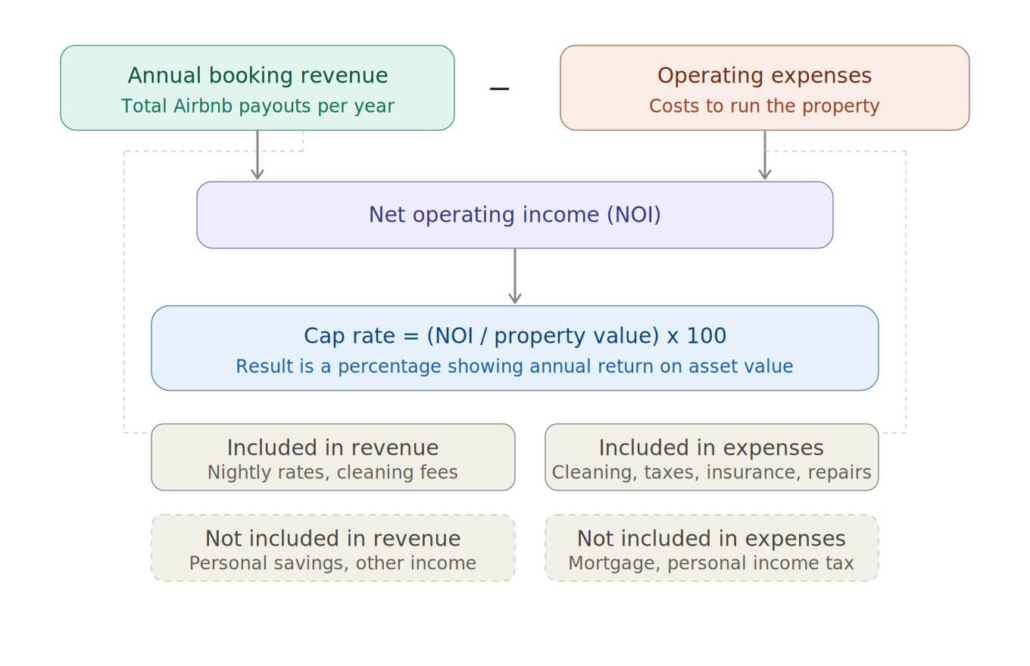
Cap Rate = (Annual Net Operating Income ÷ Current Market Value of the Property) × 100
The key term here is Net Operating Income, often shortened to NOI. This is your gross annual booking revenue minus every recurring cost tied to running the property. Think cleaning, management fees, insurance, municipal taxes, repairs, supplies, and utilities.
What NOI does not include is your mortgage payment or personal income tax. Those are tied to you as an owner, not to the property as an asset. Cap rate is meant to evaluate the building itself, regardless of how it was financed.
Check out Vacation Rental Accounting Basics: What Hosts Must Know.
Putting the Formula to Work: A Canadian Example
Numbers make this clearer. Imagine you own a furnished two-bedroom unit in the Okanagan region of British Columbia. The property is currently worth $480,000 on the open market, and your Airbnb bookings over the past twelve months totalled $44,000.
Here is a realistic snapshot of your annual operating costs:
- Post-guest cleaning and laundry service: $6,400
- Property management company fee (15% of bookings): $6,600
- Municipal property taxes: $3,200
- Home insurance with short-term rental rider: $1,780
- General maintenance (appliances, plumbing, paint touch-ups): $2,300
- Internet, hydro, water, and gas: $2,640
- Consumables, linens, and small furnishing replacements: $1,250
- Airbnb’s host service fee (roughly 3%): $1,320
Your total annual expenses add up to $25,490. Subtract that from $44,000, and your NOI lands at $18,510.
Now plug it in: ($18,510 ÷ $480,000) × 100 = 3.86%
That 3.86% is your Airbnb cap rate. It tells you exactly how productive this property is as a standalone investment, stripped of any financing or tax considerations.
Explore Best Airbnb Statistics & Analytics Tools for Hosts and Investors.
How to Interpret Your Result
So is 3.86% any good? The answer depends on context, but here are some general reference points that experienced rental investors tend to use.
- A cap rate sitting below 4% often signals that the property’s value has outpaced its earning potential. You might still benefit from long-term appreciation, but as a cash-producing asset, the margins are slim.
- Results in the 4% to 6% zone are common in larger Canadian cities and popular U.S. coastal markets. Property prices in these areas tend to be steep, which compresses the ratio even when nightly booking rates are strong.
- Landing between 6% and 8% generally points to a healthy balance between acquisition cost and rental income. Many mid-sized vacation towns and emerging tourism areas fall into this bracket.
- Anything above 8% is often found where property prices remain accessible but short-term rental demand is growing quickly. These can be attractive opportunities, though they sometimes carry less predictability.
Compared to traditional twelve-month leases, Airbnb listings tend to produce higher cap rates because nightly pricing captures more revenue per occupied night. That said, the trade-off involves greater month-to-month variability and higher operating costs.

The Variables Behind Your Number
Your Airbnb cap rate is not fixed. It shifts as conditions change, and understanding the main drivers helps you stay ahead.
Geographic Market Conditions
Where your property sits affects both sides of the equation. A cottage near Revelstoke, BC, might cost $575,000 and produce strong winter bookings, resulting in a cap rate near 6.5%. A similarly sized apartment in central Vancouver could cost $950,000 and produce solid year-round income, yet only return around 3.8%. Higher property values do not always mean higher profitability.
The Character of Your Rental
Properties with a distinctive identity tend to earn more per night. A converted barn, a waterfront A-frame, or a stylishly designed studio can justify premium pricing that a standard apartment in a competitive building cannot. That extra revenue flows straight into your NOI and lifts your cap rate without changing the denominator.
Revenue Distribution Across the Calendar
A property that pulls in 65% of its annual income during a three-month summer window might still show a reasonable yearly cap rate. But the off-season months can mean tight cash flow. Rentals that attract bookings more evenly across all four seasons tend to deliver a steadier financial picture.
Your Spending Habits as an Operator
Revenue gets the spotlight, but cost management often has a bigger impact on cap rate. Renegotiating your cleaning arrangement, bundling insurance policies, or switching to energy-efficient fixtures can trim $2,000 to $3,500 off your annual expenses. On a $480,000 property, that alone moves your cap rate by 0.4 to 0.7 percentage points. That kind of improvement is the equivalent of booking several extra nights per year.
Explore:
Turning Cap Rate Into an Ongoing Tool
Calculating your cap rate once gives you a useful snapshot. Reviewing it regularly turns it into a decision-making instrument.
Set a quarterly check-in. If the number drops, ask why. Lower bookings? A spike in maintenance costs? A jump in your property’s assessed value? Each cause has a different fix, and noticing the change early gives you time to respond.
Cap rate is also one of the clearest ways to compare two properties side by side. If you are deciding between adding a second listing in Canmore versus one in Charlottetown, the cap rate of each gives you a fair, apples-to-apples measure of expected return. Square footage, design, and geography may differ wildly, but this single number speaks the same language for both.
For hosts with multiple listings, ranking each property by cap rate reveals where your portfolio is performing well and where it might need attention. That insight can guide decisions about pricing adjustments, renovation budgets, or whether it is time to sell an underperformer.
Looking at the Full Financial Picture
Cap rate is powerful, but it works best alongside other metrics. The occupancy rate shows how consistently your listing fills. Average daily rate tracks your pricing power. Cash-on-cash return factors in your mortgage to reveal what you earn on the cash you actually invested in. Together, these numbers give you a well-rounded understanding of your property’s financial health.
The Airbnb hosts who build lasting income tend to be the ones who treat their rentals like real businesses, with real financial tracking. Cap rate is one of the most efficient ways to start doing exactly that.
And if managing the numbers, the guests, and the day-to-day operations feels like more than you want to handle solo, working with a professional property management team can free up your time while keeping your returns on track.