


How to Become an Airbnb Experience Host: Requirements, Process, and What to Expect
Table of contents
- What Airbnb Experiences Actually Are
- Experiences vs. Rental Hosting: Two Very Different Models
- Who Can Qualify as an Airbnb Experience Host
- What Airbnb Expects Before Approving Experience
- Step-by-Step: How to Become an Airbnb Experience Host
- Creating a Listing That Gets Approved (and Booked)
- The Approval and Moderation Process
- What Airbnb Experience Hosts Actually Earn
- Popular Experience Formats That Perform Well
- What Separates Successful Experiences from Forgettable Ones
- Common Mistakes New Hosts Make
- Real Challenges Airbnb Experience Hosts Face
- Is Becoming an Airbnb Experience Host Worth It?
Key Takeaways
- With Airbnb Experiences, your skill or local knowledge becomes the product.
- No property ownership is needed, but you must prove deep knowledge of your activity through formal training, five-plus years of practice, heritage ties, or media recognition.
- A human reviewer evaluates every submission, and proposals without a distinctive angle get turned down.
- Because you charge per guest rather than per night, filling more seats directly multiplies your earnings.
- You must hold your own commercial liability policy; Airbnb’s supplementary coverage only applies after yours is used up.
- Five or more vertical, high-resolution photos alongside a detailed itinerary and compelling description are what tip the scales during approval.
- Early guest reviews shape how prominently your listing appears in search, so first impressions matter disproportionately.
- Hosts in high-traffic tourist cities who schedule several sessions weekly tend to see the most consistent income.
- The platform deducts a 20% fee from every completed booking.
What Airbnb Experiences Actually Are
Airbnb launched Experiences as a standalone product alongside its rental marketplace. Instead of offering a place to sleep, you offer something to do. Think cooking classes in your kitchen, street art walking tours, surf lessons, pottery workshops, or guided hikes through trails only locals know about.
The format works for anyone with a teachable skill, deep local expertise, or access to something guests can’t easily find on their own. You don’t need a hospitality background or a property portfolio. A sommelier, a retired fisherman, a graffiti artist, a yoga instructor, or a beekeeper can all qualify. What matters is that your activity delivers something personal, specific, and memorable.
The booking process mirrors what travellers already know from renting a home on the platform. A guest finds your activity, picks a date, pays online, and arrives ready to participate. Your job is to deliver the experience. The platform takes care of payment processing, review collection, and a supplementary liability program called ELI that costs you nothing extra. One critical detail, though: Airbnb insists that every host maintain a separate commercial insurance policy suited to the activity. The ELI program is secondary; it only responds once your own coverage is fully spent.
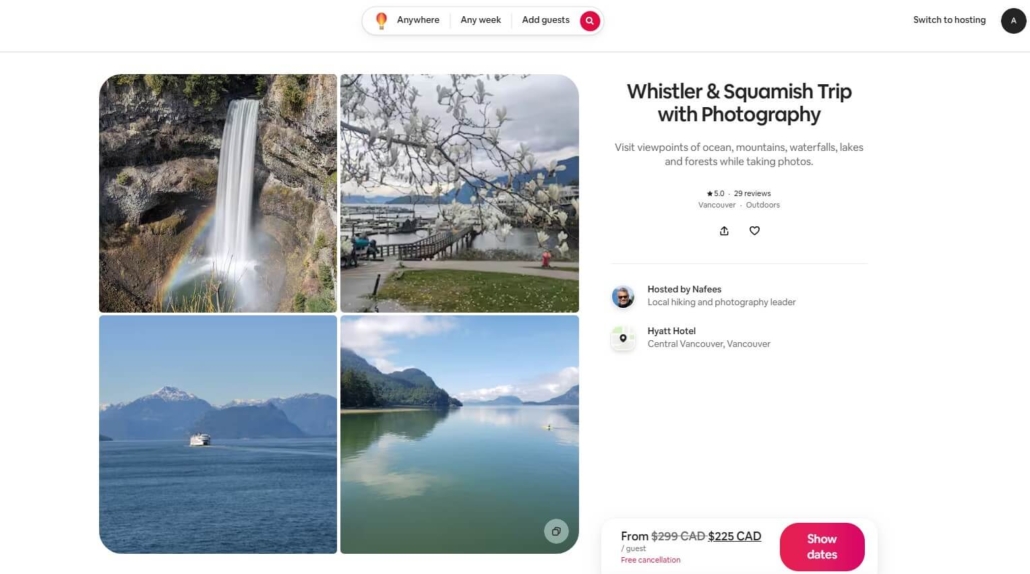
Experiences vs. Rental Hosting: Two Very Different Models
The two models share a platform, but they run on very different economics. Rental hosting requires property, furnishing, cleaning, and ongoing maintenance. Experiences require your time, expertise, and preparation, but no real estate.
Revenue behaves differently too. A rental generates income per night, limited by one calendar. An experience generates income per guest per session, and you can run multiple sessions in a single day. That scalability is the key financial advantage. A host who charges $60 per person for a 3-hour food tour and fills 8 spots earns $480 per session before Airbnb’s 20% fee.
On the flip side, involvement is higher on a per-session basis. You show up every time you perform, you interact. There’s no passive income here. Burnout is a real risk if you schedule too aggressively without building in breaks.
For property owners already listing on Airbnb, experiences open up a second income channel. Bundling a stay with a locally hosted activity gives travellers a richer trip and gives you a reason to boost your overall Airbnb earnings without adding another property.
Who Can Qualify as an Airbnb Experience Host
The platform screens every applicant before granting access. You’ll go through an identity check, and depending on your location, a criminal record review may also be part of the vetting. Once that baseline clears, Airbnb looks at three areas.
First, proven knowledge of your craft. Airbnb’s Experience-specific standard asks you to demonstrate formal training or a strong relevant background. The platform checks whether you meet at least one of these benchmarks:
- five or more years of hands-on practice in your field
- multi-generational or heritage-based knowledge passed down through family
- documented media coverage and endorsements that position you as a leader in your area of expertise
This bar is deliberately high; the platform wants hosts who can teach or guide with genuine authority. Licences and certifications bolster your case further, and for regulated categories (guiding, food service, transporting guests) you may need to upload documents through Evident, Airbnb’s external verification partner.
Second, local or cultural relevance. Your activity should connect to what your city or region is recognized for, whether that’s cuisine, history, art, nature, or a living cultural tradition. Airbnb favours hosts who provide insider access that travellers couldn’t replicate on their own. A food tour led by someone who grew up in the neighbourhood beats a generic city walk assembled from a guidebook.
Third, hosting ability. Communication, reliability, and a warm personality matter. You’re not just delivering content; you’re hosting people. The soft skills are half the product.
Separately, you’ll need a commercial liability policy of your own. For certain activity types, the platform may request documentation confirming your coverage before publishing your listing.
What Airbnb Expects Before Approving Experience
The platform maintains a detailed quality checklist, and reviewers apply it rigorously during moderation. Think of these less as guidelines and more as gates your proposal must clear.
| Criterion | What the Platform Looks For | Why It Can Make or Break Your Application |
| Identity screening | Verified personal identity; criminal record review where local law permits | Establishes baseline trust for guests booking a face-to-face activity |
| Knowledge depth | Formal training in your field, OR five-plus years of hands-on practice, OR heritage/multi-generational expertise, OR media endorsements proving authority | The single most scrutinized criterion; Airbnb wants hosts who can teach or guide with real credibility |
| City and culture tie-in | The activity connects to what your city or region is known for, whether cuisine, art, nature, or local traditions | Experiences that feel “anywhere” get rejected; local roots are non-negotiable |
| Active participation | Guests do something, not just watch; the format encourages connection between participants and the host | Passive sightseeing belongs on a bus tour, not an Airbnb Experience |
| Licences and coverage | Current permits, certifications, and a liability insurance policy matching your activity | Non-negotiable for regulated activities; Evident handles document verification |
| Suitable venue | A space that is clean, well-equipped, typically used for this type of activity, and sized for the number of guests you accept | Cramped or unsafe locations trigger rejections and poor reviews |
| Visual proof | At least five colour images in portrait format (800 x 1,200 px minimum), free of overlaid text, AI manipulation, or selfies | Photos are the first thing guests evaluate; low-quality images stall bookings |
Falling short on even a single row is grounds for rejection. Among all the reasons proposals get turned down, the most frequent is a missing differentiator. Pitching a generic neighbourhood stroll in a city that already lists dozens will almost certainly fail.

Step-by-Step: How to Become an Airbnb Experience Host
- Step 1. Create or log into your Airbnb account. Already hosting a rental? Your existing profile works. There’s no need for a separate sign-up.
- Step 2. Open the Experience application. Look for “Host an Experience” inside the hosting area of your dashboard. That’s where the submission form lives.
- Step 3. Choose your activity category. Options span food and drink, outdoor pursuits, art and culture, sports, wellness, and entertainment, among others. Select whichever fits closest.
- Step 4. Build your listing. This step demands the most effort. You’ll enter a title, a written overview, a structured itinerary, the venue, maximum group size, inclusions, and anything participants need to bring.
- Step 5. Upload your images. The platform asks for five or more colour photos in portrait orientation, each at least 800 x 1,200 pixels. Every image should show you actively running the activity. Selfies, computer-generated visuals, AI-altered shots, and stock photography are all grounds for rejection.
- Step 6. Set your price and schedule. Choose a per-guest rate. Block out dates and times you’re available. The calendar stays entirely in your control.
- Step 7. Send it off for review. After filling everything in, hit submit. A member of Airbnb’s team will evaluate the proposal by hand. Don’t be surprised if a follow-up email arrives asking you to upload licences or proof of insurance via Evident.
Creating a Listing That Gets Approved (and Booked)
Your listing is your sales pitch. Every element either builds trust or creates doubt.
Title
Open with a verb that signals action: “Explore,” “Taste,” “Discover,” or something equally direct. Then get specific. “Discover Secret Jazz Bars of Montreal” grabs attention far better than “Montreal Music Tour.” The more precise your title, the faster a potential guest understands what they’re signing up for.
Description
Write in first person. Explain what happens, why you’re the right host, and what guests walk away with. Avoid vague language like “amazing experience” or “unforgettable adventure.” Replace it with concrete detail: “You’ll learn to roll fresh pasta from scratch using a recipe my grandmother brought from Puglia in 1962.”
Photos
Vary your angles: pull back for wide environmental shots, move in for mid-range action, and capture tight detail on materials or finished products. Photograph yourself working with actual participants (with consent). Match each agenda item with its own dedicated image so guests can visualize the full arc. Prioritize good lighting, sharp focus, and a centred subject. Portrait format at no less than 800 x 1,200 pixels is the technical floor.
Itinerary
Divide your time into defined segments. Airbnb’s listing standards require a sequenced outline covering at least three distinct activities from start to finish. Guests want a clear picture of how those 2 or 3 hours play out. Vague promises like “we’ll wander around” lose bookings to hosts who spell it out: “11:00, we tour the spice stalls; 11:45, we cook together in the open-air kitchen; 12:30, we sit down to eat what we made.”
Pricing
Study comparable listings in your city first. Look at what other hosts charge for similar duration and group sizes, then position yourself accordingly. Underpricing signals low quality, while overpricing without clear justification kills conversions. First-time hosts typically land somewhere between $30 and $80 per guest, depending on location and what’s included. One operational detail worth noting: the platform sets no minimum headcount, so you’re committed to running the session even when a single guest books.
Explore Maximizing the Potential of Airbnb Listing Descriptions.
The Approval and Moderation Process
No algorithm decides your fate here. An actual staff member reads through your submission and measures it against the platform’s published standards.
Timeline: Plan for a wait of several weeks. Cities with heavy tourism volume see longer queues, and in some cases Airbnb places applicants on a waitlist. Proposals involving physical risk or specialized gear (rock climbing, boating, anything requiring transport) tend to undergo extra vetting and may trigger requests for licence or insurance uploads before a decision lands.
Common rejection reasons:
- The activity already exists in your market with no clear differentiator
- Photos are low quality, show no real guests, or look staged
- The description is vague and doesn’t communicate what makes the experience special
- Safety protocols are missing for physical or outdoor activities
- The itinerary lacks structure or detail
If rejected, you can revise and resubmit. Airbnb typically provides feedback on what to fix. Treat the first rejection as editing notes, not a final verdict.
What Airbnb Experience Hosts Actually Earn
Income from experiences varies enormously. A host running weekend pottery classes in a small town earns differently from someone leading daily food tours in downtown Toronto.
Your revenue depends on four variables:
- price per guest
- group size
- session frequency
- seasonality
A host charging $55 per guest with groups of 6, running 4 sessions per week, generates roughly $1,320 per week in gross bookings. After Airbnb’s 20% service fee, that drops to about $1,056. Subtract your material and transport costs, and your net take-home emerges.
Seasonality hits hard. Tourist-driven experiences peak in summer and during holidays. Shoulder months can see bookings drop by 50% or more. Hosts in cities with year-round tourism (Vancouver, Toronto, Montreal) have a natural advantage over those in seasonal destinations.
Building a strong pricing strategy helps here, even though the mechanics differ from rental pricing. Testing different price points in your first month reveals what your market will bear.

Popular Experience Formats That Perform Well
| Format | Example | Typical Price Range (CAD) |
| Food and cooking | Handmade pasta class, street food crawl | $50 to $120 |
| Outdoor adventure | Guided kayak tour, sunrise hike | $40 to $100 |
| Art and creative | Pottery workshop, watercolour session | $45 to $90 |
| Cultural immersion | Indigenous storytelling, neighbourhood history walk | $30 to $70 |
| Wellness | Sound bath, forest therapy session | $35 to $80 |
| Photography | Photo walk with editing tips | $40 to $85 |
Food-related experiences consistently rank among the highest earners because they combine a universal interest with a tangible outcome guests can taste and photograph.
What Separates Successful Experiences from Forgettable Ones
Four factors predict long-term success more than anything else.
- Reviews matter most. Your first 5 to 10 reviews establish your listing’s reputation. Go above and beyond for early guests. A 4.9-star average with 30 reviews outperforms a 4.7 with 100 in Airbnb’s search rankings.
- Uniqueness sustains demand. If three other hosts in your city offer the same type of tour, your bookings will stagnate. Find your angle and protect it.
- Consistent quality builds repeat referrals. Guests who loved your experience recommend it to friends and family visiting the same city. Word of mouth is the cheapest marketing channel you’ll ever find.
- Responsive communication converts browsers into bookers. Reply to inquiries quickly. Answer questions with detail. A slow or generic response costs you the booking every time.
Common Mistakes New Hosts Make
- Pitching too broad an activity. “Explore the city” isn’t an experience. “Discover 5 hidden street art murals in Kensington Market with the artist who painted them” is. Narrow your focus.
- Writing a weak description. If your listing reads like a template, guests scroll past. Inject personality, specifics, and your personal connection to the activity.
- Pricing without research. Setting your rate based on what you think your time is worth, rather than what the local market supports, leads to either empty calendars or undervalued work.
- Skipping the itinerary structure. Guests are buying certainty, and Airbnb requires at least three outlined activities in your sequence. A minute-by-minute breakdown isn’t necessary, but clear phases (arrive, learn, do, wrap up) signal professionalism.
Real Challenges Airbnb Experience Hosts Face
- Competition in popular categories is fierce. Food tours in major cities are saturated. Therefore, standing out requires either a genuinely novel concept or exceptional execution.
- Airbnb’s quality requirements evolve. The platform periodically updates its standards, and existing listings can be reviewed and paused if they no longer meet the bar. Making significant changes to your listing after publication (such as shifting the venue or overhauling your offerings) triggers a fresh round of vetting. Staying informed matters.
- Operational logistics add up. Sourcing ingredients, maintaining equipment, managing bookings, handling cancellations, and dealing with no-shows all consume time beyond the experience itself. And because there’s no headcount floor, you could find yourself running a full session for a single attendee. Hosts who treat logistics casually burn out faster than those who build lightweight systems from day one.
Is Becoming an Airbnb Experience Host Worth It?
- The case for it: Low barrier to entry, no property required, flexible schedule, scalable group-based income, and a creative outlet that lets you share what you love with people from around the world.
- The case against it: Income is inconsistent, the 20% platform fee is significant, every session demands your physical presence, competition in popular categories is intense, and seasonal demand swings can make planning difficult.
Experiences work best for people who genuinely enjoy hosting and have a skill or knowledge base that translates into a compelling activity. If you’re motivated purely by income and dislike performing for groups, this model will wear you down quickly.For hosts who already manage rental properties, experiences offer a smart way to diversify. Pairing a great stay with a local activity creates a competitive edge that generic listings can’t match. And if managing both the property and the experience feels like too much, that’s exactly where professional property management steps in to handle the rental side while you focus on what you do best.