
Can Guests Use Your Airbnb for Photography and Filming?
Key Takeaways
- Airbnb gives hosts an explicit setting to allow or prohibit commercial photography and filming; the decision sits with you, not the platform.
- Ordinary holiday snapshots are standard and expected; brand campaigns, influencer sessions, and video productions are a separate category that requires prior host consent.
- Allowing shoots can bring in a higher nightly rate, organic social media exposure, and bookings that fill gaps your leisure calendar leaves open.
- AirCover’s damage and liability protection applies to overnight stays but does not automatically extend to non-staying crew members or production-related activities.
- Pre-booking signals such as questions about lighting, room access, and visitor count can reveal a planned shoot before you confirm the reservation.
- A written shoot policy inside your house rules manages risk more effectively than a blanket ban with no explanation.
- Commercial clients typically budget for a location fee on top of the nightly rate, so additional charges are both reasonable and standard.
- Properties with distinctive interiors, unusual architecture, or strong visual character are best positioned to market themselves as dedicated shoot locations
Introduction
Short-term rentals have quietly become go-to shoot locations for content creators, brands, and photographers who need a real, styled space without studio rates. An Airbnb with the right interior costs a fraction of a commercial venue and delivers the kind of lived-in aesthetic that performs well on social media.
This article covers what Airbnb’s commercial photography policy actually allows, when to say yes or no to shoot requests, how to price them, and what it takes to protect your property when guests arrive with cameras.
Why Guests Are Booking Airbnbs for Photo and Video Shoots
More guests arrive today with cameras than with suitcases. The creator economy now includes over 200 million active content creators worldwide. Many of them face the same challenge: finding a visually compelling space at a manageable cost. A photography studio in a major Canadian city can run hundreds of dollars per hour. An Airbnb with the right interior, booked for a night or two, typically delivers the same aesthetic for far less.
Businesses also increasingly book short-term rentals for product shoots, brand videos, and e-commerce catalogues. Airbnb photography and filming requests have grown alongside demand for authentic, real-world backdrops. However, this creates a genuine hosting question: is the opportunity worth the added complexity?
What Airbnb’s Policy Actually Covers
Airbnb distinguishes between two types of guest photography. Personal photos taken during a stay, such as travel memories or holiday content, fall within normal guest behaviour and require no special host permission. Commercial photography and filming are a different matter entirely.
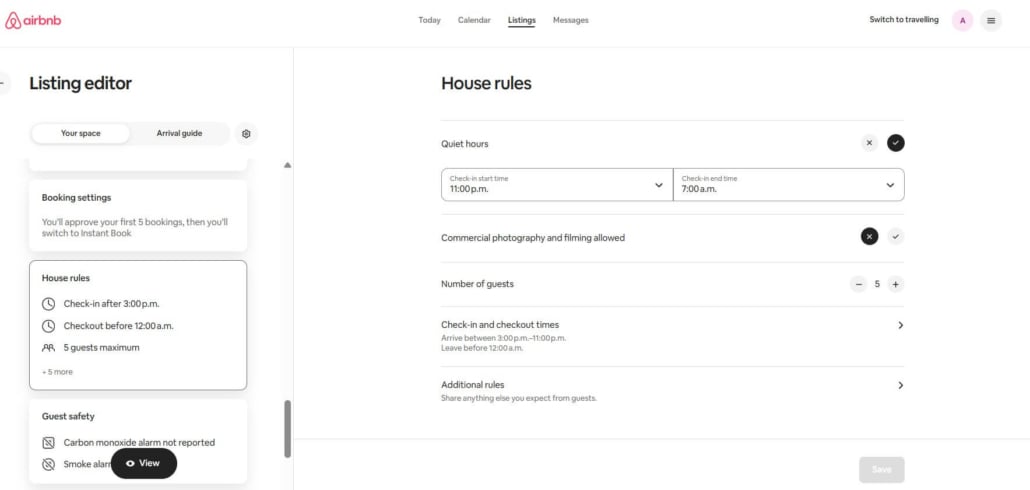
Within your listing settings, Airbnb includes a toggle specifically for commercial photography and filming. If you disable it, any professional shoot is a policy violation. When you enable it, guests have platform-level permission to conduct commercial shoots. That said, most experienced hosts still layer their own conditions on top: prior approval, participant limits, a shoot fee, and a written agreement.
One coverage detail is particularly important. AirCover provides up to $3 million in host damage protection and $1 million in host liability insurance. Both apply to stays on the Airbnb platform. Production crew who are not registered guests, hired talent, and activities beyond an ordinary stay may not be covered. Hosts who regularly accept Airbnb photography and filming bookings should confirm their position with a dedicated short-term rental insurer.
What Hosts Stand to Gain
Allowing shoots creates advantages that standard overnight bookings rarely deliver.
- Higher income per booking. Commercial clients typically pay a premium above the standard nightly rate. A separate location fee on top of your regular pricing reflects the commercial value of your space, and most production clients build this into their budget.
- Organic promotion. When a brand publishes content filmed at your property, that footage reaches their audience at no cost to you. A micro-influencer with 30,000 followers posting a styled image from your listing can generate enquiries that advertising alone cannot match.
- Calendar gap coverage. Production bookings frequently land on mid-week dates that leisure travellers skip. A photographer needing the space on a Tuesday and Wednesday is solving the hardest occupancy problem on your calendar.
Risks to Consider Before Saying Yes
Shoots carry risks that go well beyond what typical overnight guests bring.
Crew members, stylists, and assistants are often not listed on the booking. A party of three guests can arrive with eight people on site, each interacting with your furniture, flooring, and fixtures. That extra foot traffic accelerates wear. Furthermore, professional equipment creates its own hazards: lighting rigs scratch floors, tripods fall, and background materials need surface space that usually means your furniture.
Shoots also run loud and run long. Neighbours in condominiums or townhouses may complain about noise or unusual activity, especially when production extends into evening hours. Check your strata rules and lease obligations before agreeing to any shoot involving a crew.
Pros and Cons for Hosts: Commercial Shoots at a Glance
| Factor | Advantage | Risk |
| Income | Higher per-night rate; location fee possible | May not offset damage without proper insurance |
| Calendar | Fills mid-week and off-season gaps | Preparation time reduces availability |
| Exposure | Organic social promotion at no cost | Brand association you cannot control |
| Wear and tear | Minimal with small, vetted crews | Accelerated with large or unsupervised groups |
| Client relationships | Repeat bookings from creative clients | Higher time cost per booking than standard guests |
When to Allow Shoots and When to Decline
Personal lifestyle photography by a couple documenting their trip is low-risk and creates no issues in most circumstances. Similarly, a solo content creator filming short videos for a modest following is generally manageable.
The risk profile rises with scale. A full brand campaign or a production team requiring five or more extra people on site is a different matter. That scale moves beyond what AirCover and standard Airbnb terms adequately cover, so a separate written agreement and commercial-level insurance are responsible requirements. Student film projects typically sit in between: small budget and modest crew, but still requiring clear terms around hours, participant limits, and damage responsibility.
How to Spot a Planned Shoot Before Check-In
Most guests planning a shoot reveal it before arriving. Specific questions about natural lighting or window orientation, requests for room dimensions or ceiling heights, queries about extra visitors, and bookings from business email addresses are all common signals. None is conclusive alone. However, two or more arriving in the same message thread warrant a direct question: “Are you planning any photography or filming during your stay?”
Guests with legitimate intentions almost always confirm openly. Evasive or vague responses are a warning sign worth taking seriously before you accept the booking.
Should You Charge a Separate Shoot Fee?
Your nightly rate is built around one use case: a guest sleeping in the property. A commercial shoot uses the space in a fundamentally different way, with longer effective hours and greater wear. A separate fee reflects that reality.
Example Pricing Approaches
| Shoot Type | Suggested Approach |
| Personal lifestyle content, solo creator | Standard nightly rate; no extra fee needed |
| Micro-influencer or small brand (2 to 5 people) | Nightly rate plus a 25 to 50% location surcharge |
| Commercial brand or e-commerce shoot | Separately quoted location fee per project |
| Film or TV production | Direct negotiation with a dedicated production agreement |
Your Airbnb pricing strategy sets the accommodation baseline, but the shoot premium reflects the commercial value of your space. Properties with strong design identity or prime locations can justify proportionally higher fees.
Writing Shoot Rules into Your House Policy
Clear rules prevent most disputes before they start. Your Airbnb house rules should cover:
all photography and filming must be disclosed and approved before booking confirmation;
- a maximum participant count applies at all times including crew;
- shooting hours have a defined end time;
- commercial use requires written consent and a fee;
- the booking guest bears responsibility for any damage during the shoot.
Keep each rule short. Guests read rules that take under 30 seconds to scan. Detailed conditions belong in a welcome message or a separate commercial agreement.
Protecting Your Property During a Shoot
The most effective step is also the most straightforward: photograph every room in detail before check-in. Include floor corners, upholstery, walls, and any fragile decorative items. Beyond documentation:
- Remove or secure any items with high sentimental or monetary value before the shoot date
- Restrict access to rooms not required for the production
- Confirm the maximum participant count in writing before accepting the booking
- Keep all shoot-related communications within the Airbnb platform to preserve a clear record
If damage occurs, the Airbnb damage policy covers up to $3 million in host protection, but timestamped before-and-after photos submitted within 24 hours are what determine whether a claim succeeds.
Common Mistakes Hosts Make
Two patterns come up repeatedly. First, hosts who block all photography without any framework lose profitable bookings and give guests no path forward, even when they would have complied with reasonable terms. A blanket ban is not a policy; it is an absence of one.
Second, hosts who enable commercial photography without updating their house rules or documenting the property’s condition are accepting risks they have not thought through. Ignoring the commercial nature of a booking because the guest seems pleasant is how avoidable damage claims arise.
The practical middle ground: personal photography is welcome; commercial shoots require disclosure, consent, and a fee.
Can Filming Become a Dedicated Revenue Stream?
For properties with strong visual character, this question is worth exploring. Listings with unusual interiors, architectural details, dramatic views, or distinctive design attract repeat creative clients once word spreads in production circles.
Some hosts in design-forward cities like Vancouver and Toronto earn a meaningful portion of their monthly revenue from production bookings. The tradeoff is more negotiation time and thorough preparation before each shoot. Separating your shoot availability from your standard calendar prevents production clients from displacing leisure guests during peak demand.
Explore:
- Top Unique Airbnb Stays in Manitoba: Cabins, Domes & Treehouses
- Best Unique Airbnbs in Quebec: Mirrored Cabins, Geodesic Domes & Northern Lights Stays
- Unique Airbnb in Ontario: Most Unique Stays, Romantic Cabins & Winter Getaways
- Best Unique Airbnbs Alberta: Cabins, Yurts, Domes & Silos
- Unique Airbnbs in Nova Scotia: Top Oceanfront Cottages, Domes & Hot Tub Getaways
- Top Unique Airbnb in BC, Canada
Conclusion
Airbnb photography and filming requests are a growing part of the hosting landscape, driven by the creator economy’s expansion and the demand for authentic shoot locations. For hosts, this creates a genuine opportunity to earn more per booking, reach new audiences organically, and fill calendar gaps that leisure travel cannot cover.
The risks are manageable: clear written rules, thorough pre-stay documentation, direct pre-booking communication, and appropriate insurance address most scenarios. Hosts who run into problems are typically those operating without any framework at all. If managing shoot enquiries alongside pricing and property maintenance sounds like more than you want to handle, professional property management covers exactly this. MasterHost supports hosts across Canada, the UAE, and multiple other markets with end-to-end hosting operations.